

Figuring out how long you need to hang onto business records can feel like a minefield. The most important thing to remember, though, is the six-year rule. For most UK businesses, this is the gold standard for financial and tax documents demanded by HMRC and Companies House. Think of it as your business's 'financial memory'.
Understanding UK Business Record Retention
Your business records—every invoice, receipt, and bank statement—tell the story of your company's financial journey. Keeping this history isn't just about good housekeeping; it's a legal must-have that proves you’re playing by the rules and protects you when you need it most.
This is especially true for small and medium-sized businesses. Get your records in order, and you'll find it easier to file accurate tax returns, keep a healthy cash flow, and even secure a loan. Crucially, that paper trail is your best defence if you ever face a tax investigation or a commercial dispute. Without it, you're leaving yourself wide open.
The Foundation of the Six-Year Rule
At its core, the requirement to keep records comes straight from government bodies like HMRC. The widely accepted benchmark in the UK is to keep your core business records for at least six years from the end of the last financial year they relate to.
Let's say a small Bristol company has a financial year ending on 31 March. If they send an invoice on 10 January 2020, that document needs to be kept safe until at least 31 March 2026. This six-year window gives the authorities plenty of time to review your accounts if they decide to.
Holding onto documents for the correct duration is fundamental to good governance. It ensures you can answer any questions from HMRC, validate your financial statements, and protect your company from potential legal challenges down the line.
For a quick overview, here’s a look at some of the most common record types and their retention periods.
Quick Guide to Common UK Record Retention Periods
| Record Type | Governing Body | Minimum Retention Period |
|---|---|---|
| Accounting Records (Invoices, Receipts) | HMRC & Companies Act | 6 years after the financial year ends |
| VAT Records | HMRC | At least 6 years |
| PAYE Records | HMRC | 3 years after the tax year ends |
| Company Statutory Books (e.g., meeting minutes) | Companies Act | 10 years |
| Employer's Liability Insurance Certificates | Health and Safety Executive | 40 years from the date of issue |
| Accident Books & Injury Reports (RIDDOR) | Health and Safety Executive | 3 years from the date of the last entry |
This table is a great starting point, but always double-check the specifics for your industry.
Beyond the Six-Year Guideline
While the six-year rule is a solid starting point, it doesn't cover everything. As you can see from the table, different documents are governed by different rules, and you need to be aware of them.
- Company Records: Official documents like your board meeting minutes need to be kept for a minimum of ten years.
- Employee Records: Some HR files, particularly those related to workplace accidents or health surveillance, have much longer lifespans.
- VAT Records: These fall neatly under the six-year rule, so keep them for at least that long.
Getting a handle on these different requirements is a key part of running a tight ship. If you're looking to dig deeper, it’s worth reading a practical guide to managing compliance risk.
Understanding these details is the first step toward building a solid document management plan. For your most immediate files, simple solutions like a professional leather document holder can keep things organised. A structured approach not only keeps you compliant but makes finding what you need, when you need it, a breeze.
A Detailed Breakdown of Document Retention Schedules
While the ‘six-year rule’ is a great starting point, knowing precisely how long to keep specific business records is a bit more nuanced. Different documents fall under different rules and regulations, which means a one-size-fits-all approach isn’t just inefficient—it’s a genuine compliance risk. The only way to get this right is with a formal retention schedule.
Think about a busy manufacturing business in Leeds, for example. They're juggling everything from short-term payroll slips to long-term property deeds, not to mention health and safety logs from workplace incidents. Each of these documents has its own retention timeline, dictated by a specific legal reason.
This timeline gives a clear picture of how a typical business record moves from creation to its final retention date.
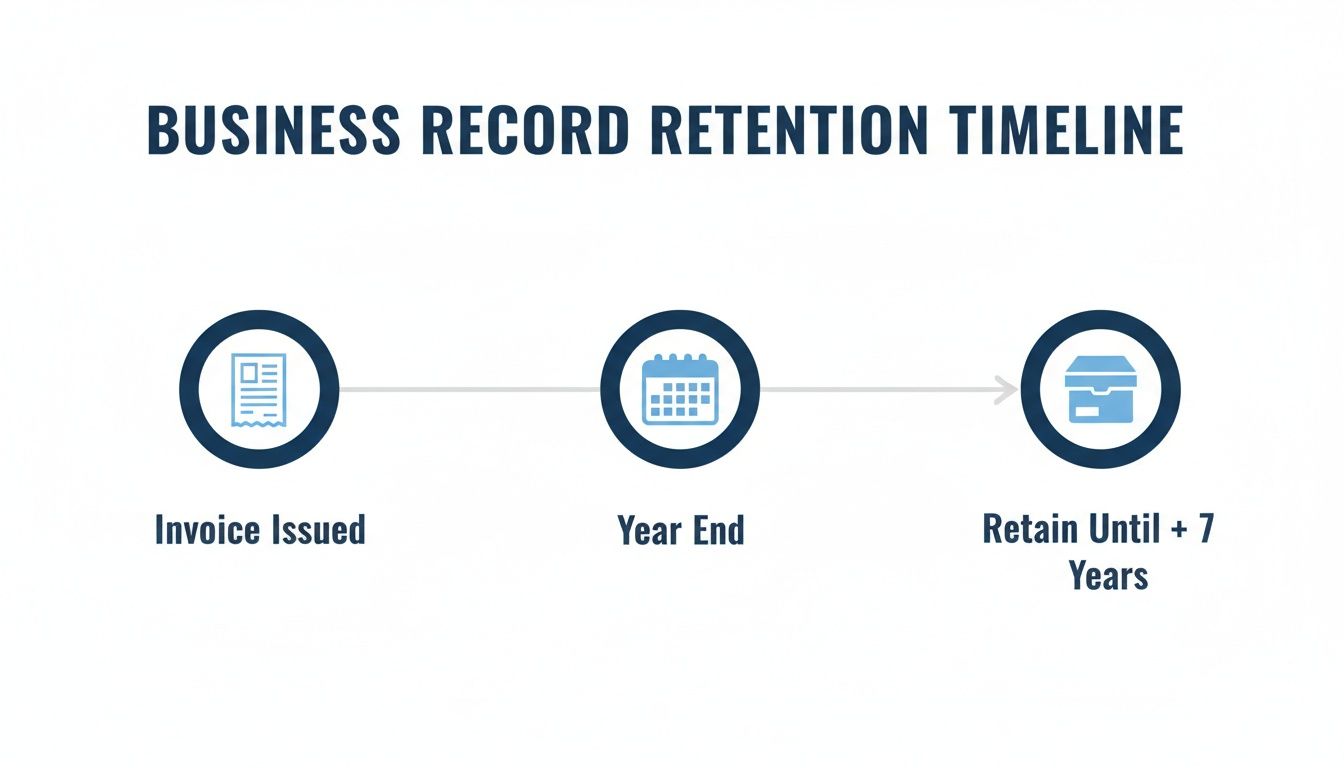
As you can see, the countdown doesn't always start on the day a document is created. It often begins at the end of the relevant financial year, which can add almost another year to how long you need to keep it.
To help you get a handle on this, here’s a practical breakdown of the most common document types and their minimum retention periods.
UK Business Record Retention Schedule
This table breaks down the key categories of business records, their minimum retention periods, and the legal reasons behind them. It's a great starting point for building your own company’s retention policy.
| Document Category | Specific Record Type | Minimum Retention Period | Legal Justification / Authority |
|---|---|---|---|
| Company & Corporate | Meeting Minutes (Board & Shareholder) | 10 years | Companies Act 2006 |
| Register of Members & Directors | Life of company | Companies Act 2006 | |
| Articles of Association | Indefinitely (Permanent) | Companies Act 2006 | |
| Accounting & Financial | Invoices, Receipts, Expense Claims | 6 years from end of financial year | HMRC |
| VAT Records | 6 years | HMRC (Making Tax Digital) | |
| PAYE Records | 3 years from end of tax year | HMRC | |
| Employee & HR | Personnel Files, Employment Contracts | 6 years after employment ends | Limitation Act 1980 / UK GDPR |
| Accident Books (RIDDOR reports) | 3 years from date of last entry | Health & Safety at Work Act | |
| Statutory Leave (Maternity, Paternity) | 3 years after end of tax year | HMRC | |
| Hazardous Substance Exposure Records | 40 years | Control of Substances Hazardous to Health (COSHH) | |
| Contracts & Agreements | Standard Contracts (under hand) | 6 years after contract end | Limitation Act 1980 |
| Deeds (e.g., property leases) | 12 years after contract end | Limitation Act 1980 |
This schedule highlights just how varied the requirements are. Now, let’s dig a bit deeper into the reasoning behind these timeframes.
Company and Corporate Governance Records
These are the core documents that tell your company’s story—its structure, key decisions, and legal identity. It’s no surprise they have some of the longest retention periods, as they form the official history of your business for shareholders, directors, and authorities like Companies House.
- Meeting Minutes: Keep minutes from board and shareholder meetings for at least 10 years. They're the definitive proof of how and why major company decisions were made.
- Register of Members and Directors: This is a live document that must be maintained for the entire life of your company. It’s the permanent record of who owns and runs the business.
- Articles of Association: Think of this as your company's constitution. It’s a permanent document that you should hold onto indefinitely.
Accounting and Financial Records
This is the stuff that tracks the financial heartbeat of your business, and HMRC has very strict rules here. These are the documents used to verify your tax and VAT returns, making the six-year rule absolutely critical for most of them.
Sticking to these timelines is non-negotiable for tax compliance. A well-organised archive of financial records is your first and best defence in an HMRC audit, proving your returns are accurate and helping you avoid hefty penalties.
You need to be ready to produce these records whenever asked. That includes:
- Invoices, Receipts, and Expenses: Keep these for 6 years from the end of the financial year they relate to.
- VAT Records: All documents related to your VAT returns must be kept for a minimum of 6 years.
- PAYE Records: Hold on to these for at least 3 years after the end of the relevant tax year. This covers everything from employee payments to deductions.
Employee and HR Documents
When it comes to employee records, you're walking a fine line between employment law and data protection duties under UK GDPR. The retention periods here are often tied to the time limits for potential legal claims, like those heard in employment tribunals.
It’s vital to have a clear policy on how long you keep an ex-employee’s personal data. Different records have wildly different retention periods. For example, employment contracts should be kept for six years after an employee leaves, but accident books might only be needed for three years—unless a hazardous substance was involved, which could push the retention period to 40 years. If you want to explore the specifics, you can find out more about UK data retention guidelines to ensure you’re fully compliant.
Key HR timelines to remember include:
- Personnel Files and Employment Contracts: The general rule is to keep these for 6 years after an employee has left.
- Accident Books (RIDDOR): These must be kept for 3 years from the date of the last entry.
- Statutory Maternity, Paternity, or Sick Pay Records: Hang on to these for 3 years after the end of the tax year they fall into.
- Health and Safety Records: As mentioned, records relating to exposure to hazardous substances can require retention for as long as 40 years.
Contracts and Agreements
Contracts are the legal glue holding your business relationships together, whether with clients, suppliers, or partners. The standard retention period is guided by the Limitation Act 1980, which sets out how long someone has to bring a legal claim.
For most simple contracts, a claim for a breach has to be made within six years. That’s why keeping the contract for at least this long after it has ended is such a crucial safeguard. However, for more formal agreements signed as deeds—like property leases or mortgages—the limitation period extends to 12 years, demanding a much longer retention schedule. Having these documents filed away safely means you can quickly defend your position or enforce your rights if a dispute ever arises.
The Real Risks of Poor Record Management
Failing to keep your business records in order isn't just a symptom of being disorganised; it carries serious, tangible consequences. These strict retention rules aren’t just red tape—they exist for good reason, and ignoring them can leave your business wide open to financial penalties and legal trouble. Simply hoping "it won't happen to me" is a huge gamble when the stakes are this high.

The most immediate threat usually comes from HMRC. If they launch an investigation and you can’t produce the paperwork they need, the penalties can be severe. We’re not talking about a slap on the wrist, but substantial fines that can seriously disrupt your cash flow and hamstring your operations.
The Threat of Financial Penalties
Poor record-keeping can land you a penalty of up to £3,000 per tax year from HMRC if your records are found to be inaccurate, incomplete, or unreadable. This fine applies specifically when you can't provide the evidence needed to back up your tax returns.
On top of that, a disorganised archive can quickly turn a routine enquiry into a full-blown, stressful investigation. The time and resources you'll burn trying to track down missing documents are a distraction you just can't afford, pulling you away from what you should be doing: running your business.
The real cost of poor record management isn’t just the potential fines. It’s the lost time, the operational disruption, and the immense stress that an official investigation places on you and your team.
Legal and Operational Vulnerabilities
Beyond HMRC, your legal defences can completely crumble without the right documentation. Picture facing an employment tribunal or a dispute with a supplier. If you've prematurely shredded the key evidence, you’re left defenceless and could face a costly judgement that was entirely avoidable.
Just think about these real-world scenarios:
- A contract dispute: A client claims you failed to deliver on terms agreed two years ago. Without the signed contract and all related correspondence, you have no solid ground to stand on, potentially forcing you into an expensive settlement.
- An employee claim: A former employee files for unfair dismissal. Their employment contract, performance reviews, and any disciplinary records are your first line of defence. If those documents are gone, your ability to defend the business is severely weakened.
- An insurance issue: Imagine a flood damages your premises. The insurance company asks for proof of purchase for your expensive equipment. Without the original invoices and asset register, your claim could be drastically reduced or even denied outright.
The Hidden Costs of Chaos
A chaotic archive creates constant friction in your day-to-day operations. Every minute an employee spends hunting for a misplaced invoice or an old contract is a minute not spent on productive, revenue-generating work. This wasted time really adds up, quietly draining your resources and hitting your bottom line.
A disorganised system also heightens the risk of a data breach. Sensitive documents left in unlocked filing cabinets or on unprotected servers are vulnerable. A theft or loss could lead to a breach of UK GDPR and a fresh wave of financial penalties. Knowing how long to keep business records is the first step, but having a secure, organised system is what truly protects you.
Putting a Solid Document Management System in Place
Knowing the rules for keeping business records is one thing, but putting them into practice is another. Without a robust system to manage everything, you’ll quickly find your office buried under a mountain of disorganised paperwork. A good document management system is what turns that potential chaos into a well-oiled, compliant, and genuinely useful business resource.
The first big decision is where you'll keep everything. These days, most businesses opt for physical storage, digital storage, or a practical mix of both. Each has its own pros and cons, and the best fit often depends on the type of records you have and how your business runs.
For many, a hybrid model strikes the perfect balance. You can keep recent or frequently used files digital and close at hand, while older paper documents are archived securely off-site. This approach is a brilliant way to free up precious office space and cut down on clutter.
Getting Your Physical Records in Order
Even in our increasingly digital world, paper is still a fact of life for most businesses. To stop it from taking over, you need a filing system that’s so logical anyone in your team can use it. The foundation of this system is a formal retention policy.
This is simply a document that clearly states how long to keep each type of record and when it’s safe to destroy it. It takes the guesswork out of the equation and makes sure everyone is on the same page.
Here are a few best practices to get you started:
- File Logically: A simple, effective method is to sort documents by type—like invoices, contracts, or HR files—and then file them chronologically by financial year. This makes finding anything a breeze.
- Label Everything Clearly: Create a standard labelling format for all your files, folders, and archive boxes. Make sure each label shows what’s inside, the relevant year, and the planned destruction date.
- Store It All Centrally: Have one dedicated, secure spot for your physical archives. For documents you need to keep handy, an expandable organiser can be a real lifesaver. If you want to know more about these handy tools, check out our guide on how to use an expandable organiser for documents and books.
Mastering Your Digital Files
Going digital brings incredible efficiency, but it also comes with a new set of rules—especially around data security and compliance. Your digital filing system needs to be just as organised and secure as any physical archive.
For many small businesses, secure cloud storage is the way to go. It offers easy access from anywhere, top-notch security, and automated backups, which are an absolute must for disaster recovery. If your main server ever goes down, a cloud backup means you won't lose years of vital records.
Switching to digital means you have to get serious about UK GDPR. This isn't just about secure storage; it’s about having clear processes for handling personal data and respecting people's rights, like the right to have their information deleted.
Your digital strategy should absolutely include:
- A Standard Naming Convention: Settle on a consistent way to name files (e.g.,
Invoice_ClientName_YYYY-MM-DD.pdf). It might seem small, but it makes searching for specific documents quick and painless. - Regular Data Backups: Set up an automated backup schedule. A great rule of thumb is the 3-2-1 rule: keep three copies of your data, on two different types of media, with at least one copy stored off-site.
- Strict Access Control: Not everyone needs to see everything. Use permissions to control who can view or edit sensitive files, protecting both your company's and your clients' confidential information.
By blending the best of both physical and digital approaches, you can build a document management process that’s not just compliant, but a real asset to your day-to-day operations.
Getting Rid of Old Records: The Right Way to Dispose
Knowing how long to keep your business records is one thing, but knowing how to get rid of them safely is just as important. When a document's time is up, you can't just chuck it in the recycling. That's a huge risk. You need a proper disposal policy to stay on the right side of data protection laws like UK GDPR and to stop sensitive info from ending up where it shouldn't.
If you're careless, the consequences can be serious. We're talking identity theft, corporate espionage, and some eye-watering fines. Just picture an old client invoice or an ex-employee's file being pulled out of a skip. The damage to your reputation, not to mention the potential financial hit from a data breach, makes secure destruction an absolute must.
How to Safely Destroy Paper Records
For paper documents, destruction means making them totally unreadable and impossible to piece back together. You've really got two choices here: do it yourself or call in the professionals.
- In-house Shredding: For the day-to-day stuff, a good quality cross-cut or micro-cut shredder is your best friend. These machines turn paper into tiny, confetti-like pieces, which is worlds more secure than the old-school strip-cut shredders.
- Professional Shredding Services: When you’ve got boxes and boxes of old files to clear out, a professional service is usually the smarter, safer bet. They can provide secure, locked bins for your office and even shred everything on-site while you watch. Afterwards, they'll give you a certificate of destruction, which is great for your compliance paperwork.
Making Sure Digital Files Are Gone for Good
Hitting the 'delete' key on your computer doesn't actually delete the file. It usually just marks the space as available to be used again, but the data itself can linger on the hard drive, ready to be recovered by someone with the right tools. Proper digital destruction needs to be much more final.
Simply hitting 'delete' on a computer is like tearing a page out of a book's index—the information is still there, just harder to find. For true security, you need to destroy the page itself.
This is especially critical when you’re getting rid of old computers, servers, or hard drives that have held sensitive business or client information over the years.
Here are the best ways to securely erase digital data:
- Data-Wiping Software: You can use special software to overwrite a hard drive multiple times with random data. This completely obliterates the original information, making it impossible to recover. It's a great option if you're planning to reuse or donate the old hardware.
- Physical Destruction: If the hardware is at the end of its life, destroying it physically is the only way to be 100% sure. This means either degaussing (using a massive magnet to scramble the data) or physically shredding the hard drive into tiny metal fragments.
Setting Up a Document Disposal Schedule
A routine is your best defence against things getting missed. Your disposal policy needs a clear schedule that lines up with your retention periods. This turns destruction from a frantic, once-a-year clear-out into a simple, manageable part of your business operations.
A Quick Checklist for Your Disposal Schedule:
- Quarterly Review: Set aside a specific time each quarter to go through your archived records.
- Find What's Expired: Use your main record list to pinpoint every document that's past its use-by date.
- Set It Aside: Move these expired records to a secure, dedicated spot while they wait for destruction.
- Destroy Securely: Carry out the destruction using your chosen method, whether that's firing up the office shredder or calling in your shredding service.
- Log Everything: Keep a clear log of what was destroyed, when it was destroyed, and how. This gives you a solid audit trail and proves you’re taking your data responsibilities seriously.
Why Use Professional Storage for Your Business Archives
As you get to grips with how long you need to keep your business records, a new problem often emerges: where do you actually put it all? Piles of paperwork can quickly swallow up precious office space, turning a productive area into a chaotic and inefficient archive room. This is exactly where professional self-storage steps in, offering a smart, secure solution for your business.

Shifting your archives to an off-site unit instantly gives you back valuable square footage. Imagine that cluttered corner or back room transformed into new workstations, a client meeting space, or extra room for stock. It’s a simple change that can seriously boost your operational efficiency and improve the whole feel of your workplace.
Gain Enhanced Security and Protection
Let's be honest, storing sensitive documents in a dusty back office or damp basement is a huge risk. They’re left exposed to everything from theft and fire to leaks and pests. A dedicated storage facility, on the other hand, is built from the ground up to protect its contents, giving you genuine peace of mind.
Professional storage units offer multiple layers of defence against these threats. At our facilities in Bristol, Leeds, and Slough, for instance, you’ll find:
- 24/7 Monitored CCTV: Round-the-clock surveillance is a powerful deterrent and keeps a detailed record of all on-site activity.
- Comprehensive Alarm Systems: Modern alarms provide instant alerts for any unauthorised access attempt, ensuring a swift response.
- Controlled Access: Only authorised individuals can get into the facility, keeping your unit and its contents well away from public access.
- Environmental Stability: The units are designed to shield your paper records from damp, mould, and pests—all of which can destroy crucial documents over time.
This robust approach means your archives are far safer than they could ever be on your own business premises.
A Cost-Effective and Convenient Solution
Outsourcing your document storage is often much more affordable than people assume. When you compare the monthly cost of a secure unit to the price of prime office rent, the savings become obvious. It's a savvy financial move, particularly for businesses based in expensive city centres.
Using a professional storage unit shifts the responsibility of archive management. It allows you to focus your energy and resources on growing your business, confident that your compliance obligations are being met in a secure, organised, and professional manner.
As you plan for long-term storage, it’s worth looking into expert document archiving best practices to ensure you’re handling data security and compliance correctly. A good storage partner helps you put these strategies into action without the high overheads of running your own archive. You can even streamline your organisation further with specialised furniture; to learn more, check out our guide on the Vabches Angled Style Cabinet.
Ultimately, professional storage is a practical investment in your company’s efficiency, security, and your own peace of mind.
Your Questions, Answered
Getting to grips with record retention often brings up a few practical questions. Let's tackle some of the most common ones that business owners ask, giving you clear, straightforward answers to keep you organised and on the right side of the rules.
Can I Just Scan Everything for HMRC?
Yes, you absolutely can. For most things, both HMRC and Companies House are perfectly happy with digital scans. The main thing they care about is that your digital copies are complete, clear, and a faithful copy of the original.
HMRC is quite flexible, stating you can keep records on paper, digitally, or as part of a software package. The non-negotiable part, though, is having a solid backup system. You simply can't afford to lose that data. While going digital is great for day-to-day records, it's still a good idea to hang on to the original paper versions of major legal documents, like property deeds or original share certificates.
What if My Company Shuts Down? Do I Still Need the Records?
Even if a limited company is dissolved, the responsibility for its records doesn't just vanish. As a director, you are legally required to keep all company and accounting records for six years from the date the company was officially dissolved.
Why? It's to ensure that if any investigations or claims pop up after the business has closed its doors, the evidence is still there. Ignoring this can land you in serious hot water personally, with fines or even disqualification from being a director. This is where a secure, low-cost storage solution can be a lifesaver, helping you meet this long-term duty without hassle.
What’s the Best Way to Organise Boxes in a Storage Unit?
A well-organised archive is a useful archive. If you're using a storage unit, a little bit of planning goes a long way.
- Get proper archive boxes. Use sturdy, same-sized boxes and label them clearly with the contents, the financial year, and the all-important destruction date.
- Keep a master list. A simple spreadsheet that details what's in each numbered box will save you from having to rummage through everything just to find one document.
- Think strategically about placement. Stack the boxes with the longest retention periods at the back. Keep the more recent files you might need to access closer to the front.
This simple system means you can lay your hands on any file you need in minutes and confidently know when it's time to dispose of old records.
Are the Rules Different for Sole Traders vs. Limited Companies?
The core principles are much the same, but there are a few important distinctions. Both sole traders and limited companies need to keep their tax records for the same amount of time: at least five years after the 31st January submission deadline for that tax year.
The extra layer for limited companies comes from the Companies Act. They have additional duties to keep records about directors, shareholders, and minutes from company meetings. A sole trader's paperwork is generally simpler, but they still have to be diligent about tracking all their business income and expenses to get their Self Assessment tax return right.
Keeping on top of your business archives is more than just a chore; it’s fundamental to good governance and your own peace of mind. At Admiral's Yard Self Storage, we offer secure, accessible, and affordable units that are ideal for protecting your important documents. You can free up valuable office space while ensuring your records are safe from damage, theft, or loss.